There is a quiet magic in a hand-tied bouquet — the kind that arrives wrapped in kraft paper, stems spiralling in perfect tension, as if the flowers themselves have agreed upon their arrangement. Unlike arrangements forced into foam or wired into submission, a hand-tied bouquet is alive. It breathes. It moves. And it requires a skill that takes years to master.
At Bloom Florist, every bouquet that leaves our shop is hand-tied. It is a point of pride, but also a philosophical commitment: we believe flowers should never be treated as static objects. They are living things, and the way they are arranged should honour that.
The Spiral Technique
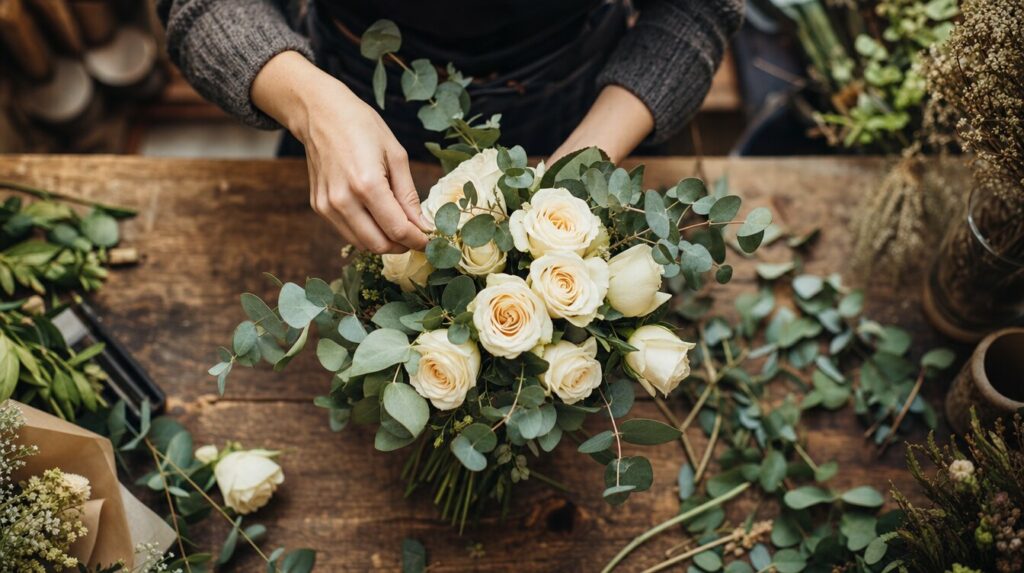
The foundation of every hand-tied bouquet is the spiral — a deceptively simple technique where each stem is placed at a consistent angle, stems crossing stems like the spokes of a wheel. The result is a bouquet that stands on its own, stems fanning out in a perfect circle, requiring no vase to hold its shape.
Mastering the spiral takes time. The florist works with one hand — the “holding hand” — which grips the bouquet at its binding point, thumb and forefinger forming a loose ring. The other hand feeds each stem into the spiral, rotating the bouquet slightly with each addition. By the time the last flower is placed, the bouquet has rotated a full 360 degrees in the hand, and every stem sits at the same angle — typically 25 to 30 degrees from vertical.
Selecting the Stems
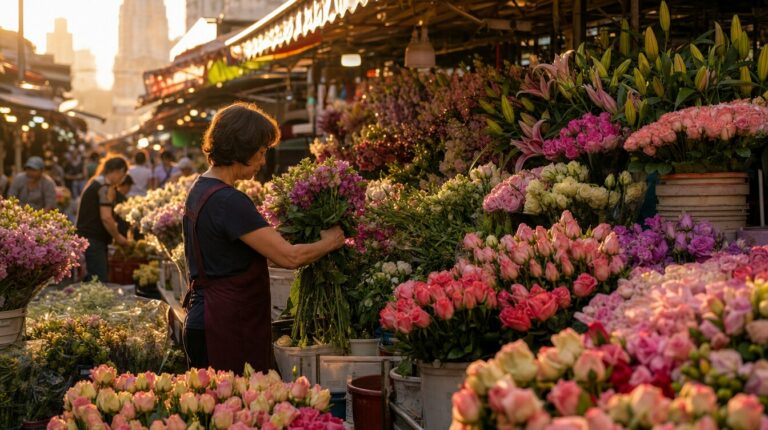
A hand-tied bouquet is an exercise in editing. Too many stems and the spiral becomes unwieldy; too few and the bouquet lacks presence. The florist must balance three elements: focal flowers (the stars — roses, peonies, dahlias), secondary flowers (the supporting cast — spray roses, ranunculus, tulips), and foliage (the texture — eucalyptus, ruscus, ferns).
The rule of thumb is rhythm, not symmetry. The eye should move through the bouquet, discovering each bloom in turn, rather than being confronted with a uniform wall of flowers. A well-tied bouquet has a front and a back, a high point and a low point, a sense of movement that mimics the way flowers grow in nature.
The Binding
The final step — the binding — is where the bouquet is secured. A single piece of twine, tied tightly at the binding point, locks the spiral in place. Too loose and the bouquet collapses; too tight and the stems are crushed. The florist learns, over hundreds of bouquets, the exact tension required — firm enough to hold, gentle enough to allow the stems to drink.
After binding, the stems are trimmed to a uniform length, and the bouquet is wrapped — in kraft paper, in tissue, in ribbon. The wrapping is not merely decorative; it protects the stems, keeps the bouquet hydrated, and frames the flowers like a picture frame frames a painting.
Why It Matters
In an age of mass production, the hand-tied bouquet is an act of resistance. It cannot be automated. It cannot be rushed. Each one is unique — a collaboration between the florist and the flowers themselves. When you receive a hand-tied bouquet from Bloom Florist, you are receiving something that was made, not manufactured. Something that carries the imprint of a human hand, a trained eye, and a genuine love for the craft.